

Did Amazon Time Prime Day Around Mercury Retrograde?
AstroStrategic Research | Case Study

Welcome to AstroStrategic Research, an ongoing series exploring public business decisions through the lens of strategy, timing, market conditions, and astrological cycles.
The goal isn’t to prove astrology.
It’s to ask better business questions.
Each article begins with a real business decision, examines publicly available evidence, and then asks what additional insight emerges when timing becomes part of the analysis.
Sometimes the patterns are compelling. Sometimes they aren’t.
Both are worth studying.
Before I was doing this work, I spent more than 25 years in corporate sales and marketing.
And in one of my last corporate roles, I called on Amazon.
Not as a customer scrolling Prime Day deals.
As a vendor trying to understand how one of the most sophisticated retail organizations in the world planned, bought, moved, promoted, and measured products.
That was during the early Prime Day years.
The event was still new. Amazon was still teaching the market what Prime Day was. And those of us selling into that ecosystem were learning right alongside them.
So when Amazon moved this year’s Prime Day out of its usual July window and into June, I noticed.
Not because I assume astrology is sitting in the boardroom.
Because companies like Amazon don’t move major commercial events randomly.
When billions of dollars, fulfillment systems, seller readiness, customer trust, and promotional calendars are on the line, timing is strategy.
So, I started asking questions.
Prime Day has only moved from its traditional July timing three times.
2020: October because of the pandemic.
2021: June while retail and supply chains were still adjusting after the pandemic.
2026: June again.
The first two make sense.
The third is different.
Amazon said the earlier timing this year was intended to allow them to capture summer shopping around the FIFA World Cup, July 4th, America 250 celebrations, groceries, and everyday essentials.
But the World Cup ran from June 11 through July 19.
Prime Day didn’t move away from the World Cup.
It moved into the middle of it.
Prime Day ended on June 26.
Mercury stationed retrograde on June 29.
That’s an observation.
By itself, it doesn’t tell us much.
But it was enough to make me wonder whether there was a larger pattern hiding in the data.
So, I started looking back.
Looking Back
I went back to every Prime Day since the event began in 2015.
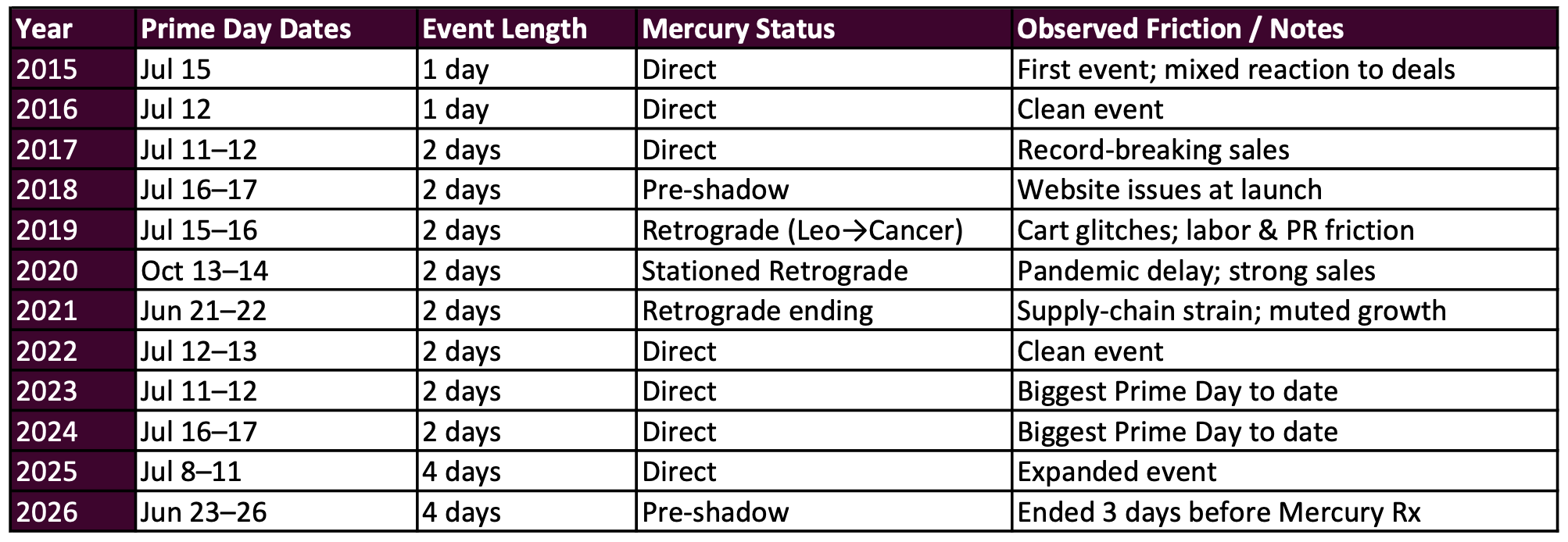
At first, I expected to find evidence that Prime Day performed poorly during Mercury retrograde.
That’s not what I found.
In fact, some of Amazon’s biggest Prime Days happened during Mercury retrograde.
The sales weren’t necessarily the story.
The friction was.
The Pattern
When Prime Day occurred during Mercury retrograde, or close to it, the event often came with additional friction.
Not failure. Friction.
Website outages and checkout glitches
Supply chain constraints
Labor disputes
Seller readiness
Scam activity and questions about trust
The event still succeeded. The system showed more of its seams.
That distinction matters.
One of the biggest misconceptions about business astrology is that Mercury retrograde means “don’t launch.”
That’s never been how I use it.
Mercury retrograde doesn’t determine success or failure.
It describes the conditions you’re likely to be operating within.
Then I Looked at Product Launches
Curious whether the pattern extended beyond Prime Day, I started looking at Amazon’s major product announcements.
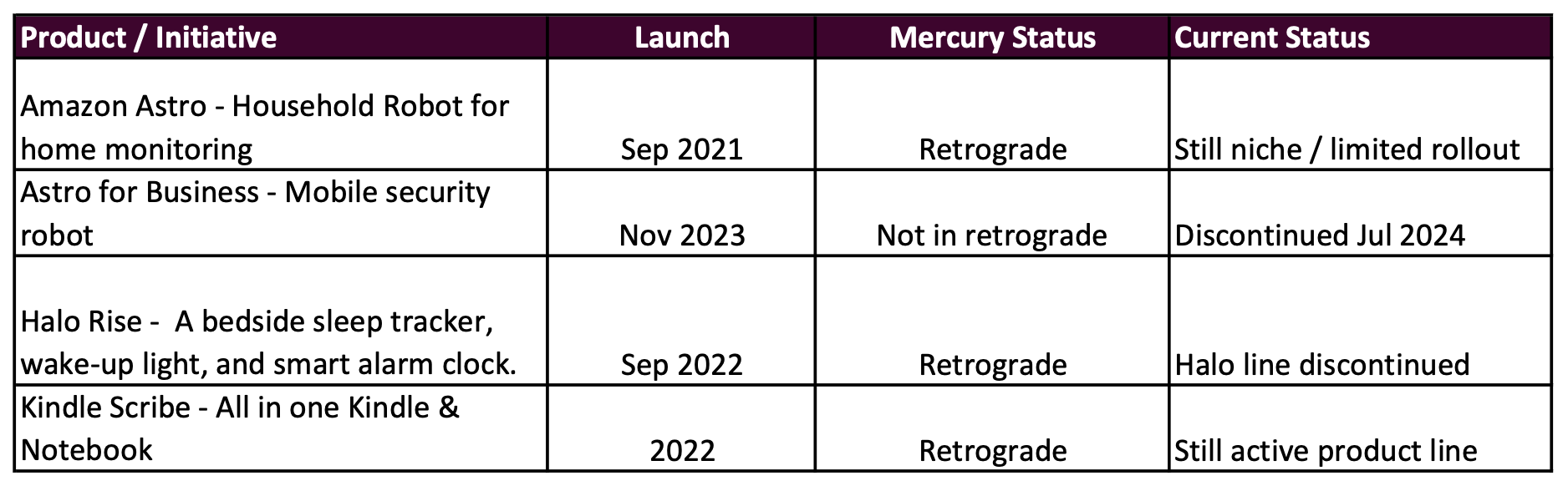
Here the pattern became even more interesting.
Several products introduced during Mercury retrograde struggled to find long-term footing.
Amazon Astro (Household Robot) remains a niche product years after launch.
Astro for Business (Mobile Security Robot) was discontinued less than a year after release.
Halo Rise (bedside sleep tracker) became part of a product line Amazon shut down.
Kindle Scribe stands as the notable exception, likely because it extended an already successful product family rather than creating an entirely new category.
Again…
This doesn’t prove astrology.
It suggests that Mercury retrograde may be less forgiving when product positioning or product-market fit isn’t already strong.
Mercury in Cancer Feels Different
This year’s Prime Day didn’t happen during Mercury retrograde.
It ended three days before.
Yet the headlines weren’t dominated by website crashes.
Instead they centered on trust.
Phishing scams
Whether the deals were actually deals
Seller readiness
Prime membership saturation
The alignment with Mercury’s retrograde through Cancer is hard to ignore.
Not “technology breaks.”
But questions of safety, protection, belonging, trust.
The conditions changed.
So did the type of friction.
What I Think This Means
I have absolutely no evidence that Amazon consults an astrologer.
And that’s not the interesting question.
The interesting question is this:
When one of the world’s most sophisticated planning organizations has complete control over the timing of one of its largest commercial events…
…what factors are they optimizing for?
Maybe it’s operational planning.
Maybe it’s historical data.
Maybe it’s another variable entirely.
I don’t know.
What I do know is this:
Looking at these events through an AstroStrategic lens surfaced patterns I wouldn’t have noticed otherwise.
And that’s exactly why I use astrology the way I do.
Not to predict whether something will succeed.
To understand the conditions it will succeed within.
The weather doesn’t determine whether you’ll reach your destination.
But it influences how you prepare for the journey.
If you’ve been noticing patterns you don’t quite have language for yet, that’s what the paid tier of Data Over Drama is for.
About AstroStrategic Research
AstroStrategic Research examines public business decisions through multiple lenses, including strategy, timing, market conditions, and astrological cycles.
The goal isn’t to prove astrology.
It’s to ask better business questions.
Every analysis is grounded in publicly available information and examines where observable business outcomes meet the conditions present at the time.
Sometimes the patterns are compelling.
Sometimes they aren’t.
Both are worth studying.
More to come!
Your Strategic Guide,
Sheri
This was interesting! Thank you for doing this :)
This is a great analysis. If they don't have astrology in the boardroom, they should hire you! I look forward to more of these articles!